

Why the health of your lake belongs in every conversation about waterfront value.
We talk a lot about docks, frontage and square footage in this business. We don't talk nearly enough about the thing that actually holds all that value together: the water itself.
This August, I want to talk about blue-green algae. Not to alarm anyone, and certainly not to suggest Muskoka has a crisis on its hands, but because it's exactly the kind of quiet, unglamorous issue that shapes property values on a lake for years, and almost nobody brings it up until it's already a problem sitting on their own shoreline.
A Small Bloom, a Big Lesson
Earlier this year, the Township of Muskoka Lakes lifted a blue-green algae advisory in Hammell's Bay on Three Mile Lake. Not far away, in our own Township of Lake of Bays, Peninsula Lake has been selected for a causation study after experiencing its own bloom, with researchers working carefully to understand exactly what triggered it, whether it was shoreline development, septic loading, warming water temperatures or some combination of the three.Neither of these is a crisis. Both are a reminder that our lakes are living systems, not static backdrops, and that what happens around them, cottage by cottage, matters more than most owners realize.
What Blue-Green Algae Actually Is, and Why It Shows Up
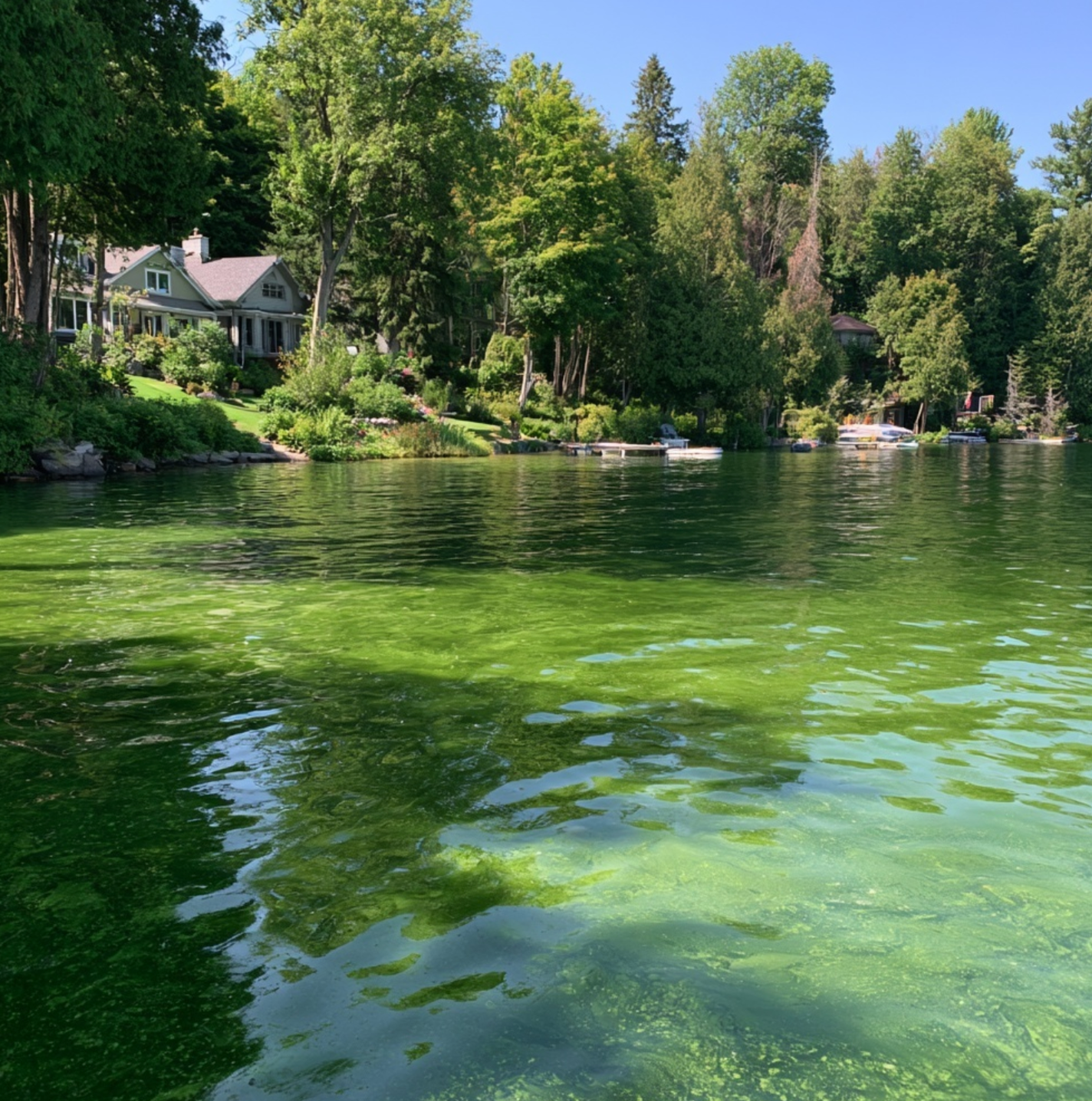
Blue-green algae, more accurately called cyanobacteria, thrives in warm, slow-moving water that's rich in nutrients like phosphorus and nitrogen. It's not new to Ontario lakes, but the conditions that encourage it, warmer summers, older septic systems reaching the end of their working life, fertilized lawns running close to shorelines, and increased shoreline development generally, have all become more common across cottage country over the past couple of decades.A bloom typically looks like spilled paint or pea soup on the water's surface, sometimes with a faint musty smell. Some blooms produce toxins that can be genuinely harmful to pets and children in particular, which is exactly why advisories get issued quickly and taken seriously the moment a bloom is confirmed.
A few signs worth knowing, so you're never guessing:
- A thick, paint-like or pea-soup sheen sitting on the surface, rather than floating clumps
- Colour ranging from bright green to blue-green, sometimes with a reddish-brown tinge
- A faint musty or grassy odour near the shoreline
- Water that looks cloudy or streaky rather than clear, even on a calm day
Why This Belongs in a Real Estate Conversation
A lake's water quality isn't separate from its property values, it's the foundation of them. I've watched this play out over years in this business: a lake with a strong, well-managed reputation holds its premium even in a slower market, while a lake with a public algae history, fairly or not, becomes a harder sell and a slower negotiation, even when the specific property in question was never affected.Buyers researching a purchase today are more informed than they've ever been. A documented algae advisory on a specific bay is exactly the kind of thing a sharp buyer, or their agent, will find with a five-minute search before they ever book a showing. Owners who understand their lake's monitoring history and can speak to it honestly, calmly and with real information are in a far stronger position, both as sellers down the road and as neighbours today, than owners who'd rather not know and get caught flat-footed by a buyer's question they can't answer.
Who's Actually Watching, and Why That Matters
The good news is that Muskoka has serious people paying close attention to this, and it's worth knowing who they are.- The District of Muskoka runs an annual recreational water quality monitoring program specifically designed to flag vulnerable lakes early, before a bloom becomes a pattern
- The Muskoka Lakes Association publishes a clear, practical algae quick guide for cottage owners who want to understand what they're looking at without wading through scientific literature.
- FOCA, the Federation of Ontario Cottagers' Associations, maintains province-wide guidance and answers the questions cottage owners actually ask.
- Local lake associations, including causation studies like the one now underway on Peninsula Lake, are doing the granular, lake-specific work of figuring out what's actually driving change on the water we all care about.
None of this requires you to become a limnologist or spend your summer reading phosphorus reports. It just means the resources exist, they're free, and they're worth five minutes of your time, particularly if you're on a smaller, shallower or more developed bay where conditions tend to concentrate.
What Every Waterfront Owner Can Do This Month
A few simple habits go a long way toward protecting the lake you love, and most of them cost very little.- Inspect your septic system on a regular schedule, particularly if your cottage is more than twenty years old or you're not entirely sure when it was last serviced. Aging systems are one of the most common, and most fixable, contributors to nutrient loading.
- Keep a natural shoreline buffer of plants, shrubs and unmowed grasses rather than manicured lawn running to the water's edge. It's one of the most effective natural filters we have, and quietly, one of the prettiest features a shoreline can have.
- Skip the fertilizer near the shoreline entirely, even the products marketed as lake-safe.
- Report anything unusual, a paint-like sheen, an unfamiliar colour or smell, to the District or your lake association rather than assuming someone else already has.
The Values Behind This
I've built my real estate practice on the belief that real estate is really about people and the places they love, not just transactions closed and commissions earned. Muskoka's lakes are the reason any of us are here in the first place, buyers, sellers and lifelong cottagers alike, and looking after them is part of looking after each other, and part of protecting the very asset we're all so proud to own.If you ever want to talk about your lake, your shoreline, a monitoring program in your area or anything in between, my door's open, no property talk required.
Whether you're seeking your first waterfront sanctuary or navigating the complexities of a cherished property sale, I'm here to guide you with clarity, insight and genuine care. Over two decades of walking Lake of Bays' shorelines have taught me that the right decision isn't just about the numbers—it's about understanding what matters most to you and your family.
Let's have a real conversation. Reach out at 705-571-2118 or jay@jayrichardson.ca and we'll chart a path forward together.
Let's have a real conversation. Reach out at 705-571-2118 or jay@jayrichardson.ca and we'll chart a path forward together.