


The Muskoka Neighbour Effect: How Adjacent Properties Shape Your Waterfront Value
By Jay Richardson, Broker | The Richardson Team — Refined Real Estate
Royal LePage Lakes of Muskoka | lakeofbayscottages.ca
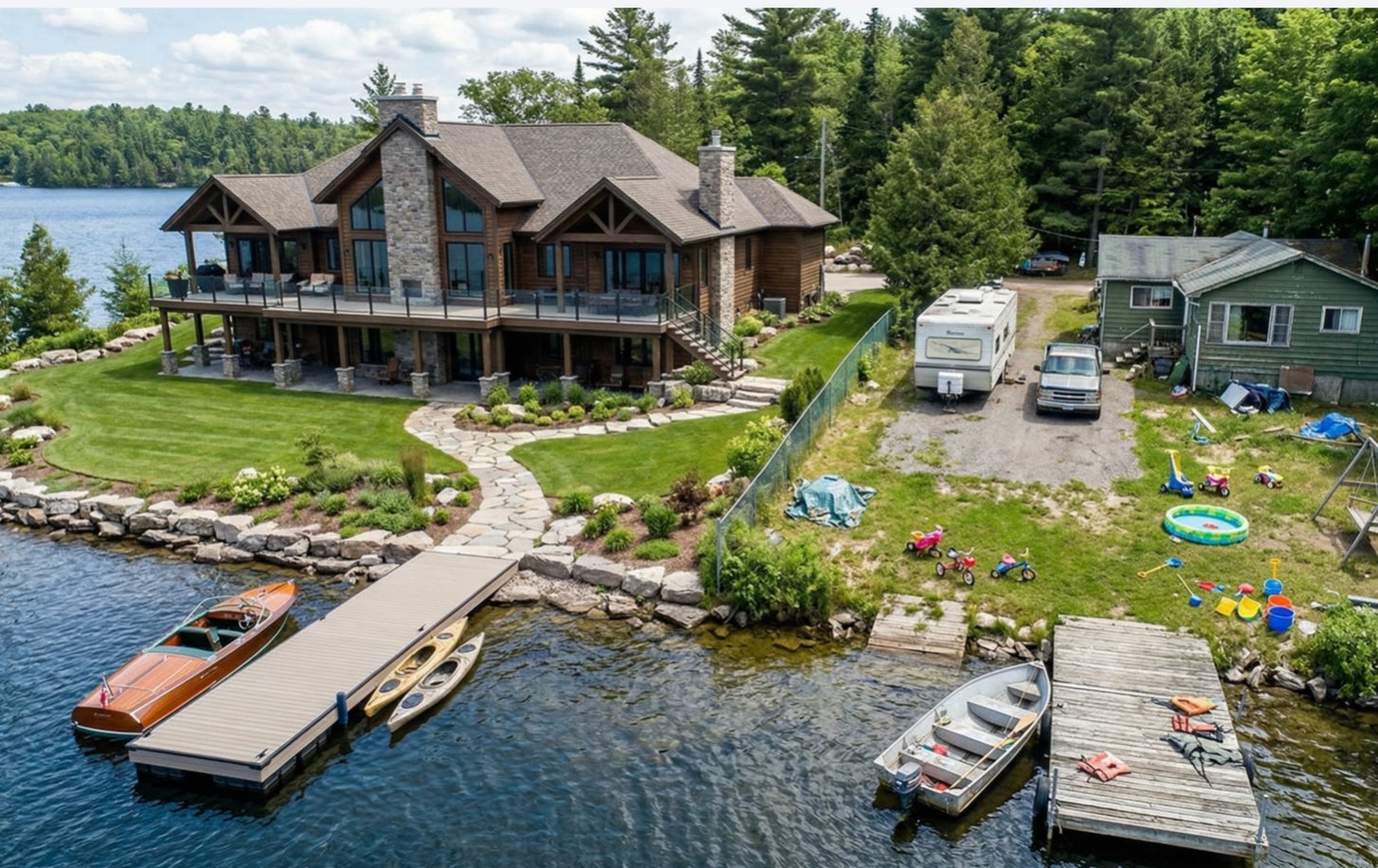
When buyers and sellers think about what determines the value of a Muskoka waterfront property, the conversation usually centres on the obvious: frontage, depth, lot size, the quality of the shoreline, the condition of the cottage itself. These are the variables that show up on a data sheet and are easy to compare.
But in more than two decades of representing clients on Lake of Bays and across North Muskoka, I have come to understand that one of the most consequential influences on waterfront value is one that almost never appears in the listing details — the properties immediately next door.
I call it the Neighbour Effect. It is real, it is measurable in outcomes if not always in dollars, and both buyers and sellers benefit from understanding it before they make their next move. The most important factor in your cottage's value might not be on your property at all.
What the Neighbour Effect Actually Means
The Neighbour Effect is not simply about whether you like the people next door. It refers to the ways in which adjacent properties — their use, their condition, their ownership structure and their future development potential — influence the desirability and marketability of your own.In an urban setting, this is well understood. In the Muskoka waterfront market, where lots are often larger, more private and separated by trees and topography, buyers sometimes assume the effect is diminished. In my experience, the opposite is true. Because waterfront properties command premium prices and attract buyers who are making significant emotional and financial investments, the quality of the surrounding environment matters enormously — and buyers do their due diligence.
For Sellers: What Your Neighbours Mean for Your Listing
If you are preparing to sell your Lake of Bays or North Muskoka property, here are the neighbour-related factors that experienced buyers and their agents will be evaluating — and that will influence both interest and price.• Short-term rental activity on adjacent lots. Properties operating as short-term rentals — can introduce unpredictable levels of noise, boat traffic and activity that buyers at the luxury end of the market are specifically trying to avoid. If a neighbouring property has a history of rental use, a knowledgeable buyer's agent will uncover it. Understanding this dynamic before you list allows you to price strategically and address it proactively in your marketing narrative.
• Derelict or significantly under-maintained properties. A neighbouring cottage in poor condition — overgrown lots, a failing dock, a structure that has not been updated in decades — creates visual noise that works against the premium positioning of your listing. This is not something you can control, but it is something your agent should acknowledge honestly rather than ignore.
• Adjacent lots with development potential. A vacant lot or an underdeveloped parcel next door can be read two ways by buyers: as a future privacy risk if it is developed, or as an opportunity to acquire additional frontage. Understanding the zoning, the setback requirements under the applicable municipal official plan and the realistic development scenarios for neighbouring lots is something I research as a matter of course before advising a seller on positioning.
• Commercial properties or marina proximity. Proximity to a marina or commercial operation introduces boat traffic, noise and activity patterns that affect the character of a property year-round. Some buyers actively seek this — easy access to fuel, service and amenities is genuinely valued. Others are specifically avoiding it. Knowing which type of buyer your property will attract allows for more precise and effective marketing.
• Shared lane or right-of-way arrangements. Many waterfront properties in the Lake of Bays area share a private lane with one or more neighbouring properties. The condition of that lane, the cost-sharing arrangement (or lack thereof) and the relationship between the parties using it are all material to a buyer's decision.
These details belong in a well-prepared seller's disclosure package. Understanding what surrounds your property is not just due diligence — it is the foundation of an honest and effective pricing strategy.
For Buyers: What to Investigate Before You Offer
If you are in the market for Muskoka waterfront, the due diligence on the property itself — the well, the septic, the shoreline, the dock classification — is well documented and widely understood. The due diligence on what surrounds that property is less commonly discussed but equally important.Here is what I advise every buyer I work with to consider before making an offer.
• Visit at different times and on different days. A property that feels serene on a Tuesday morning in May may feel very different on a Saturday afternoon in July. If your schedule allows, try to visit the property — or at minimum drive the road and the waterfront — during peak season and at a weekend. The character of the surrounding neighbourhood is something you can only understand by experiencing it, not by reading a listing sheet.
• Ask specifically about the neighbouring properties. A good buyer's agent will research this. Ask about the ownership history of adjacent lots, any known rental activity, any pending severances or development applications in the immediate area and whether there are any shared access arrangements that could affect your use and enjoyment. Municipal planning departments maintain records of development applications that are publicly accessible.
• Research the shoreline on either side. In Ontario, waterfront properties are subject to the Public Lands Act and applicable municipal shoreline policies. The dock classification of a neighbouring property, the presence of a boathouse and the permitted uses of the shoreline on adjacent lots can all affect your own experience of the water. This is research worth doing before you fall in love with a property.
• Consider what a neighbouring vacant lot could become. If there is an undeveloped parcel adjacent to the property you are considering, understand what it is zoned for and what could realistically be built on it. A vacant waterfront lot in the Township of Lake of Bays, for example, is subject to specific shoreline residential policies — but the range of what is permitted may surprise you. Your agent should be able to help you interpret this.
• Look beyond the immediate neighbours. The property two or three lots away matters less than the one sharing your boundary, but in a quiet bay with limited lots, even more distant properties contribute to the overall atmosphere. A quick look at satellite imagery and a conversation with local residents can tell you a great deal about the character of a stretch of shoreline that no listing will capture.
What This Means for Pricing and Negotiation
The Neighbour Effect rarely appears as a line item in a comparative market analysis. It is not the kind of variable that shows up cleanly in a database of comparable sales. But it influences outcomes consistently — in days on market, in the ratio of list price to sale price and in the depth of buyer interest a property generates.For sellers, a property surrounded by well-maintained, privately held, full-season cottages with stable ownership commands a premium that is real but difficult to quantify precisely. Conversely, a property adjacent to a high-turnover rental or a lot with unresolved development questions may face a narrower buyer pool and a longer marketing period — factors that experienced sellers account for in their pricing strategy from the outset.
For buyers, identifying a property where the Neighbour Effect works in your favour — where surrounding lots are stable, well cared for and unlikely to change in character — is one of the most reliable ways to protect the long-term value of a Muskoka waterfront investment.
A Note on Local Knowledge
Much of what I have described here is not available in any database or public record. It comes from knowing the market — the individual lakes, the bays, the roads, the families who have held properties for generations and the changes that are quietly underway. It comes from having been present in this market for more than two decades and from maintaining the kind of relationships that make that knowledge accessible.This is one of the reasons that representation by someone with deep local knowledge matters as much as it does in the Muskoka waterfront market. The data tells part of the story. The rest of it lives in the community.
Whether you are preparing to sell or beginning the search for your next waterfront property, I am always glad to have a grounded, honest conversation about what I know about a particular stretch of shoreline — and what the numbers alone will not tell you.
Jay Richardson is a Broker and owner of The Richardson Team — Refined Real Estate, a boutique Royal LePage Lakes of Muskoka office specializing in luxury waterfront, cottage and rural residential properties in Lake of Bays and North Muskoka. She holds the CLHMS, RENE and RSPS designations and is a Lifetime Award of Excellence recipient. Reach her at lakeofbayscottages.ca.